BloxStrike Beginner Guide: How to Play BloxStrike on Roblox
The best BloxStrike beginner guide is not the one that throws every tactical FPS concept at a new player at once. It is the one that helps a new player survive their first few matches, understand why they are losing rounds, and improve without getting overwhelmed. BloxStrike looks familiar to anyone who has played objective-based shooters before, but for newer players it can feel punishing. One bad peek, one bad buy, or one rushed push can ruin an entire round. That pressure is exactly what makes the game exciting, but it is also what makes a beginner guide necessary.
Understand the Round Structure
The first thing to understand is that BloxStrike is a round-based game. That means each life carries weight. Unlike a respawn shooter, you do not instantly get another chance every few seconds. If you die early, your team loses both firepower and map information. So the first beginner lesson is simple: do not take random fights just because you are bored. A patient player is usually more valuable than a reckless one.
Pacing and Controlled Pressure
The second lesson is pacing. Many new players confuse speed with aggression and aggression with confidence. In reality, strong tactical play is usually about controlled pressure. You move up when you have information, when you have utility support, or when your team can trade for you. You do not swing every angle alone with no plan. If you slow down and clear the obvious corners first, you will die less often and learn the map faster. First round, follow your teammates and let them lead; collect information before committing. A good first buy is M4A1-S plus a flashbang. Prefer slow play and long sightlines over rushing.
Economy Discipline
Economy is the next major idea. In BloxStrike, Credits shape what you can buy and therefore what kinds of rounds your team can realistically win. A beginner does not need to memorize every economy pattern immediately, but they do need to understand one core truth: buying randomly every round is bad. Some rounds should be stronger buys with rifles and utility. Some should be lower-cost rounds where you accept more risk and save for the future. If your team constantly enters key rounds under-equipped because everyone spent irresponsibly one round earlier, the problem is not bad luck. It is poor economy discipline.
Use Utility Before You Peek
Utility is another area where beginners can improve very quickly. A flashbang gives you a much better chance to take a contested angle. A smoke can block a dangerous lane and let your team cross safely. Even if your aim is average, utility can turn an impossible fight into a fair one. That is why new players should not save all their money only for rifles while ignoring grenades. A rifle without space or support is often weaker than players think.
Crosshair Placement and Angle Discipline
Crosshair placement is one of the easiest habits to train. Try to keep your crosshair where an enemy head is likely to appear instead of aiming at the floor and reacting late. This sounds simple, but it changes how every duel feels. The less you need to flick upward or sideways in panic, the more stable your fights become. Good crosshair placement is like pre-solving part of the duel before it starts. At medium and long range, tap or burst; save spray for close range. After each death, remember where the enemy was and use that to predict the next round.
Start with Confirmed Maps
Map learning should start with what is clearest and most confirmed, which right now means Dust II. Dust II is useful for beginners because its lanes teach basic tactical shooter ideas in a straightforward way. A Long teaches long-angle discipline. Mid teaches information fights and cross-map pressure. B tunnels teach timing, flashes, and entry risk. You do not need to know every deep callout immediately. You just need to know enough to understand where fights usually start and where defenders are likely to hold.
Watch Patterns and Improve
Another important beginner habit is watching patterns. If an opponent keeps peeking the same lane every round, punish it. If a team always stacks one site after losing the other, pay attention. Tactical shooters reward memory and pattern recognition more than many players realize. Crouch-walking and listening for footsteps also help. In the beginning, improvement is not about becoming a carry player in one night. It is about making fewer empty mistakes. Die less early. Waste less money. Use more utility. Keep your crosshair in smarter positions. Learn one map well before trying to master every map at once.
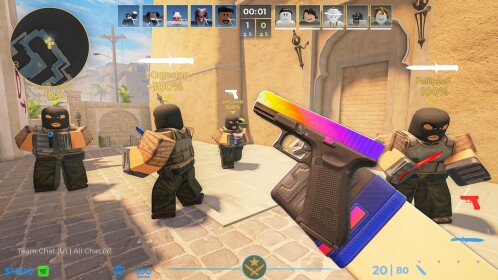
First Matches in BloxStrike
Use local gameplay screenshots to support explanations about map pressure, pacing, and angle discipline.
Next Read
Best BloxStrike Settings
Clean up video, radar, HUD, and crosshair for better visibility and consistency.
Explore More BloxStrike Guides
BloxStrike Beginner FAQ
How do you get better at BloxStrike fast?
Focus on crosshair placement, slower peeks, economy discipline, and simple utility usage before chasing advanced mechanics.
Should beginners rush every round in BloxStrike?
No. Most new players improve faster by slowing down, clearing angles, and trading with teammates.
Is BloxStrike hard for new FPS players?
It has a learning curve, but once you understand rounds and economy, it becomes much easier to read.
What page should I read after the beginner guide?
The Settings and Weapons pages are the best follow-up reads.